Newest headlines
Industrial Transformation in the Age of Artificial Intelligence – Science and Technology Park Niš at the Kopaonik Business Forum
The Kopaonik Business Forum, the most significant economic event in Serbia and the region, was held for the 33rd time this year, bringing together representatives of government institutions, the business community, the financial sector, academia, and the innovation ecosystem.
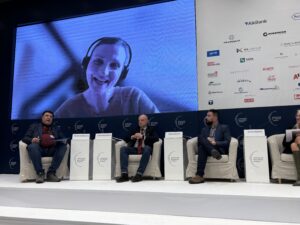
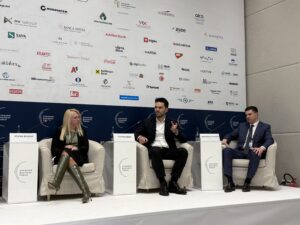
As part of the Forum program, the panel “Transforming Industry for the Intelligent Age” was held, organized in partnership between the Kopaonik Business Forum, the Serbian Association of Economists, and the Science and Technology Park Niš. The panel was moderated by Milan Ranđelović, PhD, Director of Science and Technology Park Niš.
The discussion focused on how industry can remain competitive amid the rapid development of artificial intelligence and digital technologies, as well as the role innovation ecosystems and public-private cooperation play in this process.
Panel participants included Stefan Bađa, Co-founder and Head of Accelerator and Global Partnerships at HUB 201; Jelena Bojović, Program Director for Public Policy at NALED and the World Economic Forum; Michaela Lafont, Programme and Project Coordinator for AI Innovation and Policy Coordination at the European Commission; Todor Mladenov, Member of the Board and Executive Director of Sofia Tech Park; Dragoslav Pavlović, Mayor of the City of Niš; and Ivan Pavlović, Project Manager of S4AI European Digital Innovation Hub.
During the discussion, it was emphasized that industrial transformation is no longer a topic of the future, but a process that is already actively taking place worldwide. The competitiveness of the economy increasingly depends on companies’ ability to integrate artificial intelligence into their business and production processes, as well as on the existence of ecosystems that enable the practical application of new technologies.
Milan Ranđelović highlighted the importance of connecting industry, innovation centers, and the public sector in building sustainable ecosystems. According to him, such partnerships bring benefits to local communities, create new jobs, and stimulate economic growth. He also emphasized that it is important to implement artificial intelligence in both the public and private sectors, through the engagement of local governments, research institutions, and technology parks. This approach would allow Serbia to keep pace with global trends by leveraging existing infrastructure and motivating all stakeholders involved in the development of intelligent industry.
Participants also reflected on the practical challenges companies face when introducing AI solutions. It was particularly noted that the process of scaling these technologies often begins with basic infrastructure—such as structured data and well-organized systems.
It was also pointed out that in many organizations digital tools remain fragmented, systems often do not communicate with each other, and automation is limited to individual processes. As a result, outcomes frequently depend on a small number of experts, while scaling solutions across entire organizations remains a significant challenge.